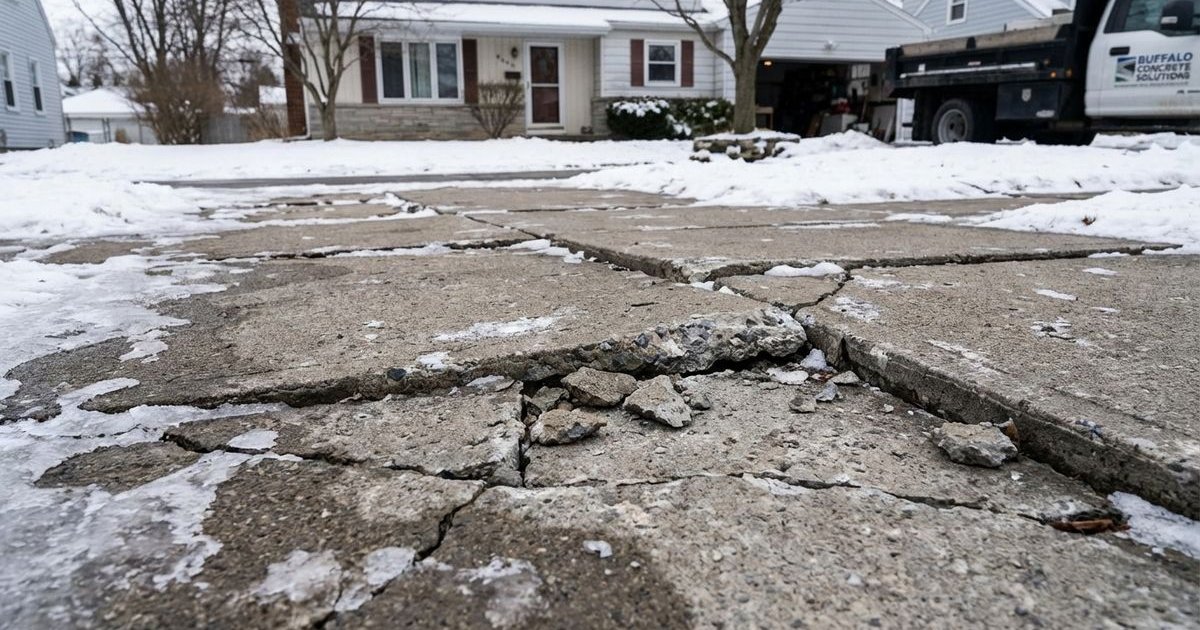
Living in Buffalo means accepting that winter is a major part of life here.
You know how everyone focuses on the massive snowfall totals we get in Western New York?
It is actually the temperature swings that do the real damage to your driveway and sidewalks.
We see the aftermath of this every single spring.
That temperature fluctuation acts like a jackhammer on rigid surfaces.
This guide breaks down exactly why our local climate is so tough on concrete and the specific steps you can take to protect your property.
The Freeze-Thaw Cycle Problem
Buffalo is famous for snow, but the frequency of our temperature changes is the real threat. National climate data indicates that regions like ours can experience dozens of freeze-thaw cycles in a single season.
We contend with this constant expansion and contraction from November through April.
Concrete is rigid and porous, which makes this cycling particularly destructive.
The Mechanics of the Damage
- Infiltration: Water from rain or melting snow soaks into the concrete’s microscopic pores and tiny cracks.
- Freezing: When the temperature drops below 32°F, that trapped water freezes.
- Expansion: Physics dictates that water expands by volume by approximately 9% when it turns to ice.
- Pressure: This expansion exerts internal pressure that can exceed the tensile strength of standard residential concrete (often rated around 3,000 to 4,000 psi).
- Thawing: The temperature rises, the ice melts, and the water recedes, leaving larger voids than before.
- Repetition: The cycle repeats, with more water filling the now-larger gaps.
Over time, this process turns microscopic defects into visible crumbles.
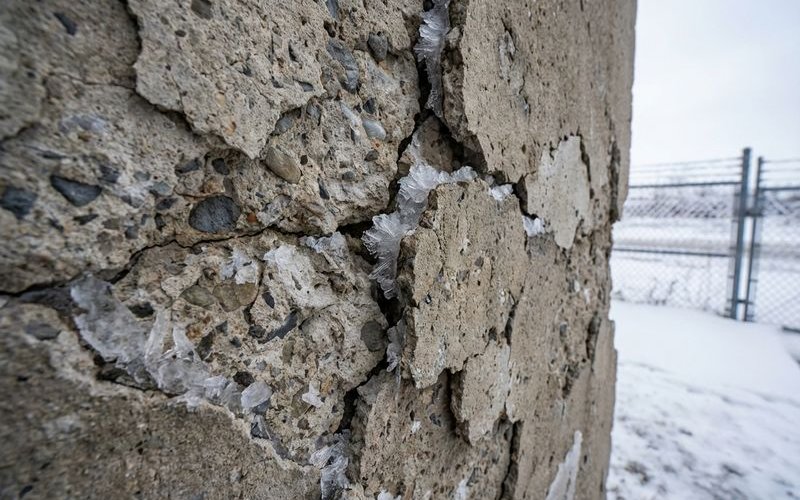
Visible Signs of Freeze-Thaw Damage
You can usually spot the difference between simple wear and tear and freeze-thaw damage.
We recommend looking for these specific indicators on your property:
Surface Deterioration
- Spalling: This looks like the top layer of the concrete is flaking or popping off, exposing the rough aggregate underneath.
- Pop-outs: These are cone-shaped fragments that break out of the surface, often caused by absorbent stones within the concrete expanding.
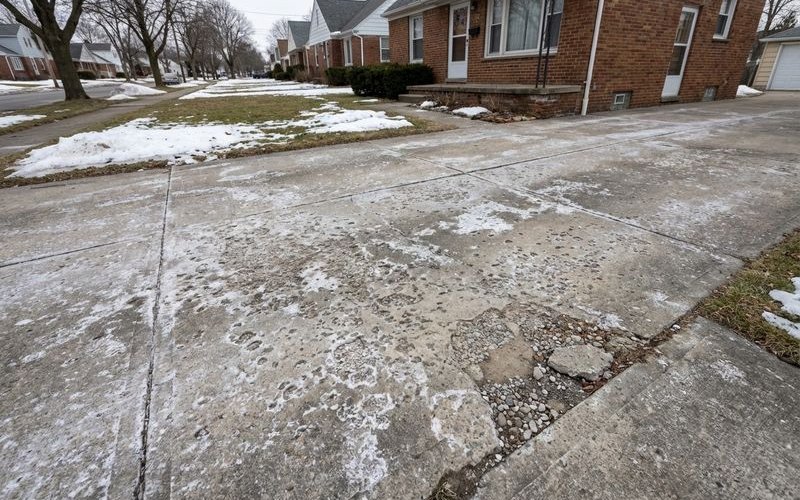
- Scaling: The surface mortar peels away in thin layers, often creating a sandpaper-like texture.
- Pitting: Small, deep holes appear where water has repeatedly frozen and compromised the integrity of the finish.
Structural Shifts
- Progressive Cracking: Hairline cracks that widen noticeably after a single winter season.
- Slab Separation: Expansion joints or cracks widening to the point where weeds grow freely.
- Accelerated Settling: Slabs sinking unevenly as the sub-base is compromised.
- Heaving: Sections lifting above others, creating immediate trip hazards.
Salt Damage: The Hidden Destroyer
Road salt is essential for safety in Buffalo, but it is aggressive on masonry.
We often see driveways ruined simply because of the de-icers tracked in from the street.
The chemical reaction does more than just melt ice.
How Salt Attacks Concrete
Salt lowers the freezing point of water, which sounds helpful, but it can actually increase the number of freeze-thaw cycles a slab endures.
It also has hygroscopic properties.
This means salt attracts and holds moisture, keeping concrete roughly 10% more saturated than untreated areas.
Here is a comparison of common de-icers and their impact on your concrete:
| De-Icer Type | Effective Temp | Impact on Concrete |
|---|---|---|
| Rock Salt (Sodium Chloride) | Down to 15°F | High Damage. Highly corrosive to reinforcement and causes severe surface scaling. |
| Calcium Chloride | Down to -25°F | Moderate Damage. Effective in extreme cold but can leave a slimy residue and corrode metal. |
| Magnesium Chloride | Down to -13°F | Lower Damage. Less corrosive and safer for pets, though still requires cleanup. |
The Physical Impact
- Surface Erosion: The chemical bond attacks the “glue” (cement paste) holding the concrete together.
- Corrosion: If you have steel reinforcement (rebar) inside your concrete, salt penetrates to rust it.
- Expansion: Rusted metal expands significantly, cracking the concrete from the inside out.
Snow Load and Soil Effects
It is not just the concrete itself that suffers; the ground underneath it takes a beating too.
We deal with Western New York soil that often has high clay content.
Clay soils are highly susceptible to water retention and volume changes.
The Weight of Lake Effect Snow
Lake-effect snow is denser than average snow.
While fluffy snow might weigh 7 pounds per cubic foot, the wet, heavy snow we often get in late winter can weigh over 20 pounds per cubic foot.
- Moisture Saturation: As these heavy piles melt, they saturate the soil next to and underneath your driveway.
- Hydrostatic Pressure: This water builds up pressure against foundation walls and beneath slabs.
- Prolonged Wetness: Piling snow on concrete keeps it saturated for weeks, increasing freeze-thaw risks.
Frost Heave Mechanics
When that water-saturated clay soil freezes, it pushes upward with incredible force.
This is called frost heave.
It can lift an entire concrete slab several inches.
When the ground thaws in spring, the soil turns to soft mud, and the heavy concrete slab sinks.
Often, it does not settle back into its original level position, leaving you with uneven joints.
What You Can Do About It
You cannot change the weather, but you can change how you maintain your surfaces.
We advise taking these proactive steps to extend the life of your driveway and walks.
Apply the Right Sealer
Not all sealers are created equal. Professional concrete sealing is one of the best investments you can make to protect your surfaces.
You should look for a penetrating Silane-Siloxane sealer rather than a film-forming acrylic.
- Breathability: Penetrating sealers allow moisture vapor to escape from the ground up, preventing the “blushing” (whitening) common with acrylics.
- Protection: They chemically bond to the concrete pores to repel water and salt.
- Longevity: A high-quality penetrating sealer typically lasts 3 to 5 years, whereas acrylics often need annual re-coating.
Manage Your Drainage
Water is the enemy of your concrete’s foundation.
- Redirect Downspouts: Ensure gutters extend at least 4-6 feet away from your driveway and sidewalks.
- Adjust Grading: Soil should slope away from the concrete to prevent pooling at the edges.
- Clear the Piles: Avoid piling snow directly on the corners of your driveway where cracking is most likely to start.
Smart De-icing Practices
Use traction agents instead of chemical melters whenever possible.
- Sand or Kitty Litter: These provide grip without chemical damage.
- Avoid Early Use: Never use salt on concrete that is less than one year old; it hasn’t cured enough to resist the chemical attack.
- Spring Cleaning: Wash your driveway with a pressure washer (using a wide fan tip) in early spring to remove salt residue.
Immediate Repairs
Small cracks let water in, which creates big cracks.
- Caulk Joints: Use a flexible polyurethane sealant for expansion joints and control cuts.
- Seal Cracks: Fill hairline cracks before November arrives.
- Level It: If a slab is tilting toward your foundation, address it immediately to prevent basement water issues.
When to Call for Professional Help
Some signs indicate damage that DIY methods cannot fix.
We recommend a professional assessment if you observe these specific issues:
Critical Warning Signs:
- Drainage Reversal: Water now flows toward your home or garage instead of the street.
- Trip Hazards: Height differences between slabs exceed 1/4 inch (a common liability threshold).
- Hollow Sounds: If tapping on the concrete produces a hollow sound, the soil support has washed away.
- Deep Structural Cracks: Cracks that run through the entire depth of the slab.
Spring is the ideal window for concrete leveling.
Modern polyurethane leveling techniques can stabilize the soil and lift the concrete back into place often for 50-70% less cost than replacement.
Protecting Your Investment
Your concrete surfaces are a functional part of your home’s value.
We know that a little preventative maintenance goes a long way in this climate.
Ignoring these issues usually leads to a full tear-out and replacement, which is significantly more expensive than maintenance.
Contact us for a spring assessment.
We will evaluate the toll winter took on your property and provide a clear, cost-effective plan to get your concrete back on level ground.