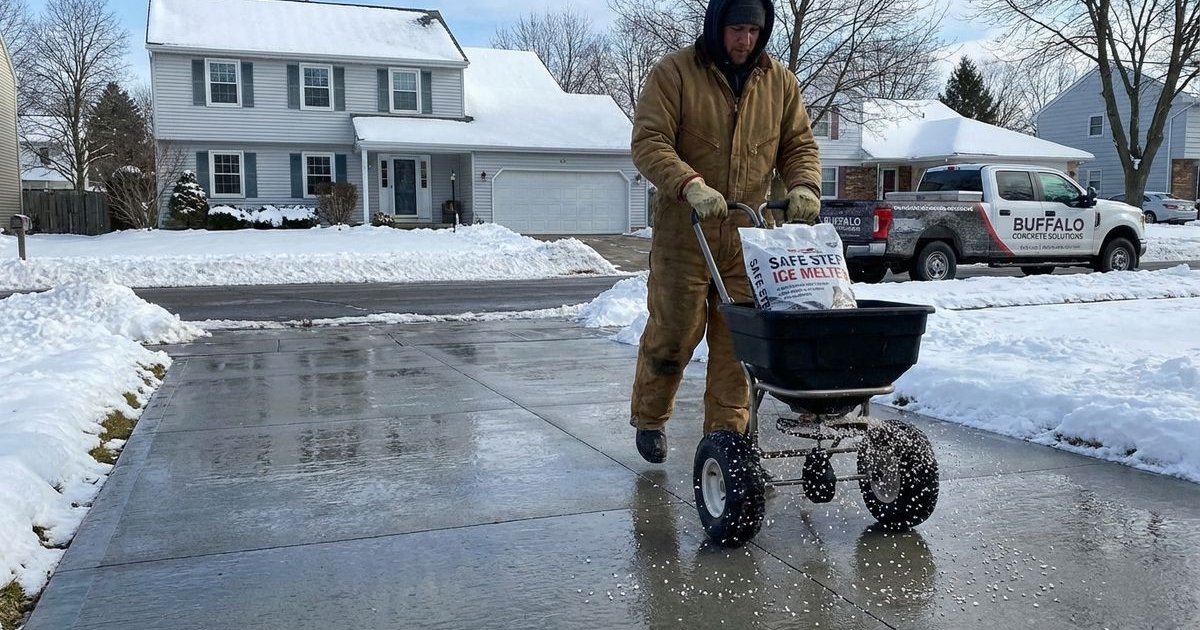
Living in Buffalo means accepting a harsh reality: winter is tough on our driveways. We know the drill—the plow comes by, the salt truck follows, and suddenly your concrete is covered in a corrosive slush.
From what we’ve seen in Western New York, it’s not actually the snow that does the most damage. It is the invisible chemical reaction happening beneath the surface that turns a solid slab into gravel.
This guide breaks down exactly why our local freeze-thaw cycles are so destructive and the specific steps you can take to stop them. We will look at the science of salt damage, the best sealing products for 2026, and how to spot issues before they become expensive repairs.
How Salt Damages Concrete
Salt attacks concrete in two distinct ways, and understanding them is key to prevention.
Chemical Reactions
Salt is hygroscopic, meaning it attracts and holds water. When salt sits on your driveway, it keeps the concrete moist far longer than it would be naturally. This trapped moisture becomes a weapon when the temperature drops. The salt also reacts with calcium hydroxide in the concrete to create calcium oxychloride. We have seen this new compound expand inside the pores, causing internal pressure that shatters the cement paste holding your driveway together.
Increased Freeze-Thaw Cycles
Buffalo is famous for its “rollercoaster” winters where temperatures swing above and below freezing constantly.
- Salt lowers the freezing point of water to around 15°F or lower.
- This creates more opportunities for water to melt and refreeze within the concrete pores.
- Water expands by about 9% when it freezes.
- This hydraulic pressure exceeds the tensile strength of standard concrete (which is often only 300-400 PSI).
Moisture Effects
A salty slab is a wet slab. Because salt draws moisture from the air, your concrete stays saturated even on dry winter days. This saturation is the primary fuel for the freeze-thaw damage described above.
Signs of Salt Damage
You can often hear salt damage before you see it.
The “Hammer Tap” Test: Take a standard hammer or a heavy chain and lightly tap or drag it across your concrete. Solid concrete will make a clear, high-pitched “ping.” If you hear a dull, hollow “thud,” that indicates delamination—a horizontal split happening just below the surface.
Look for these visible indicators:
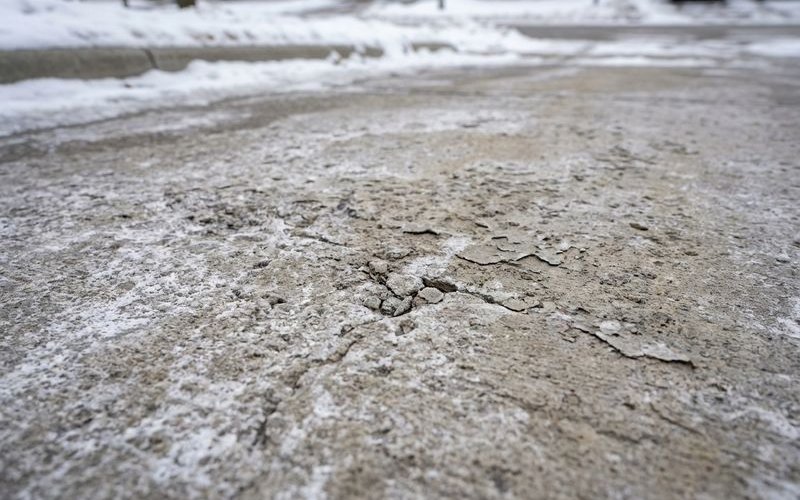
- Spalling: This is the most common sign, where the top layer flakes off in sheets.
- Scaling: Thin layers peeling away, often exposing the rough aggregate underneath.
- Pitting: Small, deep holes that look like someone took a drill to the surface.
- Pop-outs: Cone-shaped craters left behind when a specific stone inside the concrete expands and breaks the surface.
- White deposits: Also known as efflorescence, this is salt crystallizing on the surface.
- Surface roughness: The texture changes from smooth to coarse sandpaper.
Prevention Strategy 1: Apply Sealers
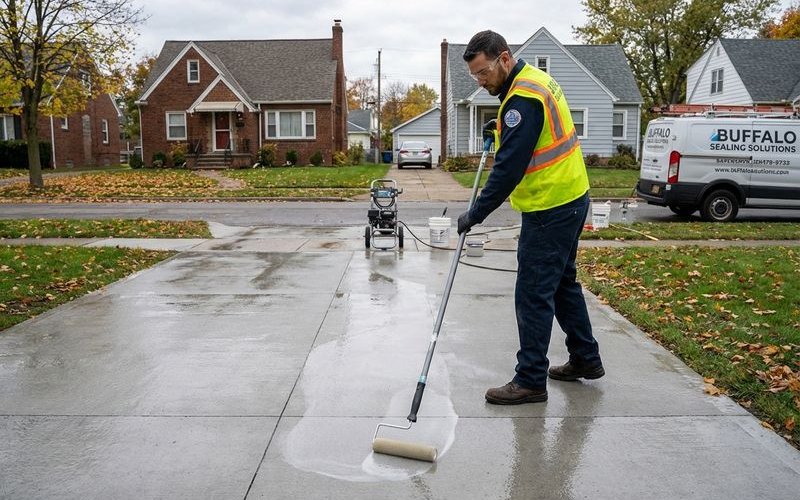
Sealing your concrete is the single most effective protection you can buy. We strongly recommend specific chemical formulations for the Buffalo climate.
Types of Sealers
Silane-Siloxane Penetrating Sealers (Highly Recommended): These are the gold standard for Western New York winters.
- They penetrate deep into the pores rather than sitting on top.
- They create a hydrophobic barrier that repels water and salt.
- They are breathable, allowing ground moisture to escape without peeling the sealer.
- Lifespan: Typically 7-10 years.
Acrylic Film-Forming Sealers: These create a plastic-like sheet on top of the concrete.
- They often become slippery when wet, which is dangerous in winter.
- They wear down quickly from plow traffic and shoveling.
- They can trap moisture, leading to the dreaded “blushing” or whitening.
- Lifespan: Often only 1-3 years.
When to Seal
- New concrete: Wait at least 28 days for the full cure.
- Existing concrete: Apply after a thorough pressure wash and 24-48 hours of drying time.
- Best timing: Late summer or early fall (September is ideal).
- Frequency: Re-apply Silane-Siloxane every 5-7 years; acrylics may need annual touch-ups.
Prevention Strategy 2: Minimize Salt Use
You can reduce damage by changing how you clear snow.
On Your Own Property
- Pre-treat with Brine: Spray a mixture of salt and water before the storm hits. This prevents the ice from bonding to the concrete and uses 75% less salt than rock salt.
- Mix with Sand: Cut your salt with sand (50/50 mix) to provide traction without the chemical burn.
- Shovel Early: Mechanical removal is always safer than chemical melting.
- Avoid “De-icers” with Ammonium: Ammonium nitrate and ammonium sulfate attack the concrete matrix directly and are far more destructive than regular salt.
From the Street
You cannot stop the city plows, but you can defend against them.
- Create a “sacrificial zone” at the end of your driveway where you don’t seal or worry about aesthetics.
- Rinse this apron area frequently on days when the temperature rises above 35°F.
- Install a driveway mat or physical barrier near the garage to catch salty runoff.
Prevention Strategy 3: Good Drainage
Standing water is the enemy.
- Check the Slope: Your driveway should have a minimum slope of 1/8 to 1/4 inch per foot away from your home.
- Clear the Edges: Edging your lawn ensures water can run off the concrete instead of pooling against the grass dam.
- Clean Drains: Keep channel drains free of ice and debris so meltwater has an escape route.
Spring Cleanup Routine
The City of Buffalo typically schedules its “Spring Sweep” around late April, but you should act sooner.
- Rinse thoroughly: As soon as temperatures hold above freezing, use a garden hose to wash away the white salt residue.
- Inspect for damage: Perform the hammer tap test on any suspicious areas.
- Sweep and clean: heavy debris traps moisture, so get it off the surface.
- Plan repairs: If you find hollow spots, schedule repairs before water gets in and freezes again next winter.
- Consider sealing: If your driveway absorbs water instantly (turning dark), it is time to reseal.
Alternatives to Traditional Salt
If you must use a melting agent, choose one that balances cost with concrete safety. Rock salt is cheap but destructive, while alternatives offer better performance at a higher price.
| Product | Performance Range | Approx. Cost (50lb bag) | Concrete Safety |
|---|---|---|---|
| Rock Salt (NaCl) | Effective to 15°F | $10 - $15 | Poor |
| Calcium Chloride | Effective to -25°F | $20 - $35 | Moderate |
| Magnesium Chloride | Effective to 0°F | $20 - $30 | Good |
| Potassium Chloride | Effective to 12°F | $25 - $40 | Good |
| Sand/Grit | Traction Only | $5 - $10 | Excellent |
| Kitty Litter | Traction Only | $10 - $15 | Excellent |
Using less product is always better than switching products. We recommend using Calcium Chloride for extreme cold days only, as it works faster and requires less volume than rock salt.
When Salt Damage Has Already Occurred
Ignoring spalling concrete will only make it expensive to fix later.
Minor damage:
- Clean the surface and apply a penetrating hardener or densifier.
- This can stop the dusting and crumbling for a few years.
Moderate damage:
- If the surface is pitted but the slab is solid, concrete resurfacing is an option.
- This involves applying a polymer-modified overlay that bonds to the old concrete.
Severe damage:
- If the concrete is hollow or sunken, it may need leveling or replacement.
- Cost Insight: Concrete leveling in Buffalo typically costs around $4 per square foot, whereas tearing out and pouring new concrete can cost $10 to $15 per square foot.
Professional Help
We specialize in saving concrete that others might say needs total replacement. Our team uses advanced leveling techniques to fix uneven slabs and prevent water from pooling and freezing.
Contact us to schedule an assessment of your driveway. We can help you determine if a simple seal is enough or if a leveling repair will save you thousands in replacement costs.