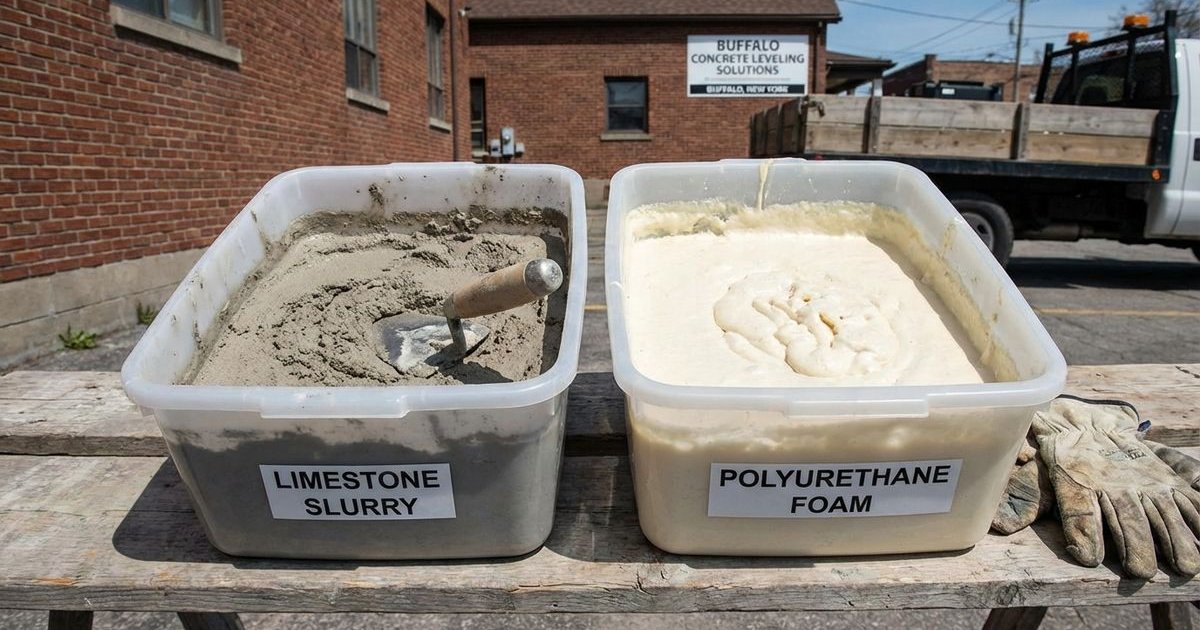
When researching concrete leveling, you’ll encounter two main methods: limestone slurry (sometimes called mudjacking) and polyurethane foam (polyjacking).
Both can lift sunken concrete, but they work very differently.
Here’s an honest comparison regarding which is better for Buffalo.
The Two Methods Explained
Limestone Slurry
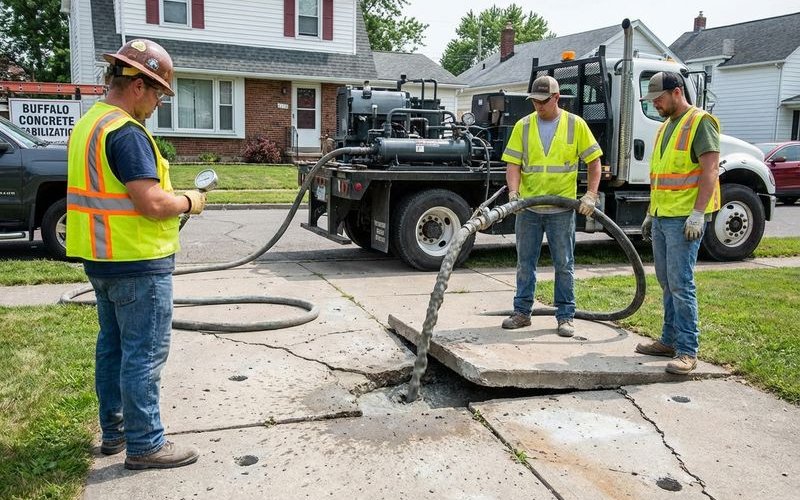
This process uses a mixture of limestone powder, water, and Portland cement that is pumped beneath the concrete through small holes. The material fills voids, stabilizes soil, and lifts the slab using hydraulic pressure. It is essentially a flowable, high-strength mortar.
Polyurethane Foam
Contractors inject a two-part chemical foam beneath the concrete. It expands rapidly through an exothermic reaction, filling voids and lifting the slab. The expansion force is what raises the concrete.
Head-to-Head Comparison
| Factor | Limestone Slurry | Polyurethane Foam |
|---|---|---|
| Weight | ~100-120 lbs/cubic ft | ~2-4 lbs/cubic ft |
| Compressive Strength | 2,400+ PSI | 50-100 PSI |
| Durability | Permanent (Stone-like) | May compress over time |
| Heat Sensitivity | Inert | Can soften in extreme heat |
| Cost | Lower | Higher |
| Material Base | Natural Stone & Cement | Synthetic Chemicals |
| Buffalo Climate | Excellent | Good |
Weight and Stability
Limestone slurry weighs significantly more than foam.
This matters because mass provides resistance against ground movement. A cubic foot of limestone slurry weighs roughly 100 to 120 pounds. It creates a dense, solid base that naturally compacts the soil underneath.
- Heavier material resists frost heave movement better.
- It provides more stable support under heavy load (like SUVs or trucks).
- The material won’t shift or float during heavy rain or snowmelt.
- It is better for high-traffic and vehicle areas.
Foam’s lightweight nature can be an advantage in rare situations, such as slabs on second stories, but it lacks the mass to stabilize the subgrade. For most residential driveways and sidewalks, the stability of limestone is preferred.
Durability Over Time
Limestone is essentially artificial stone.
Once cured, it becomes a hard, cementitious material.
- It won’t compress under the weight of a parked car.
- The material doesn’t degrade from UV rays or gasoline spills.
- It maintains density indefinitely.
- This method has been proven for 50+ years.
Foam has some durability concerns in residential settings.
- It can compress under sustained heavy loads, leading to “resinking.”
- The material may degrade if UV light penetrates the injection holes.
- Long-term data is limited as it is a newer technology compared to mudjacking.
- Chemical breakdown can occur if the mixing ratio isn’t perfect during installation.
Performance in Buffalo’s Climate
This is where limestone really shines for Western New York.
Freeze-Thaw Performance
Buffalo experiences severe temperature swings. Limestone slurry handles our annual freeze-thaw cycles excellently because it moves slightly with the earth rather than fighting it.
- It doesn’t absorb water that could freeze and expand.
- The material maintains stability through temperature changes.
- It has been proven locally for decades.
Water Resistance
Our heavy rains and snowmelt create challenging conditions for any foundation.
- Limestone doesn’t wash away once cured.
- It actually stabilizes surrounding soil by filling fissures.
- The slurry creates a solid base even with water present in the subgrade.
Cost Comparison
Limestone slurry typically costs 30-50% less than foam.
Because the materials are locally sourced and natural, the price point is much friendlier for homeowners.
| Project | Limestone Est. | Foam Est. |
|---|---|---|
| Small sidewalk | $300-500 | $500-800 |
| Driveway (2-car) | $800-1,500 | $1,500-2,500 |
| Large patio | $600-1,200 | $1,000-2,000 |
The savings are significant. You get a stronger repair for roughly half the price of the chemical alternative.
Environmental Considerations
Limestone:
- 100% natural materials (stone, water, cement).
- No harmful chemicals or off-gassing.
- Minimal processing required.
- Eco-friendly choice safe for landscaping and pets.
Foam:
- Petroleum-based product.
- Contains isocyanates which can be hazardous during application.
- Once cured it is plastic waste that does not biodegrade.
- Manufacturing process has a higher carbon footprint.
For environmentally conscious homeowners, limestone is the greener choice.
When Foam Might Make Sense
To be fair, foam has legitimate applications in specific scenarios:
- Weight-sensitive structures: If you are leveling a slab on a raised deck or weak subfloor.
- Very deep voids: Foam expands 20-30 times its volume, filling massive caverns efficiently.
- Interior finished floors: The injection holes are slightly smaller (dime size vs. quarter size).
- Difficult access: If you cannot drag a hose to the location, foam kits are more portable.
Why We Choose Limestone Slurry
After 30+ years of concrete leveling in Buffalo, we maintain that limestone is the superior choice for our region.
We rely on this method because it provides a permanent fix rather than a temporary patch.
- Reliability: It creates a rock-hard base that does not sponge or compress.
- Climate Match: It withstands the rigorous Western NY winters without failing.
- Value: It offers the best return on investment for customers.
- Safety: It is environmentally responsible and non-toxic.
- History: It is proven over decades of local use.
We could offer foam and charge more for it.
However, we choose not to because we believe limestone delivers better results for Buffalo homeowners.
Make an Informed Choice
If you’re comparing concrete leveling quotes, ask the contractor specific questions:
- What specific material composition do you use?
- Why do you choose that method for this specific soil type?
- What is your warranty regarding material shrinkage?
A reputable contractor should be happy to explain their approach.
Contact us if you’d like to discuss the best approach for your specific project.