What Is Concrete Leveling? A Complete Guide for Buffalo Homeowners
If you have ever jarred your wrist when your snowblower hit an uneven sidewalk seam in January, you know exactly why we are writing this guide. Tearing out and replacing concrete is expensive, messy, and leaves your driveway unusable for weeks. Our team has found that for most Buffalo homeowners, there is a faster, stronger solution—professional driveway leveling that saves both time and money.
What Is Concrete Leveling?
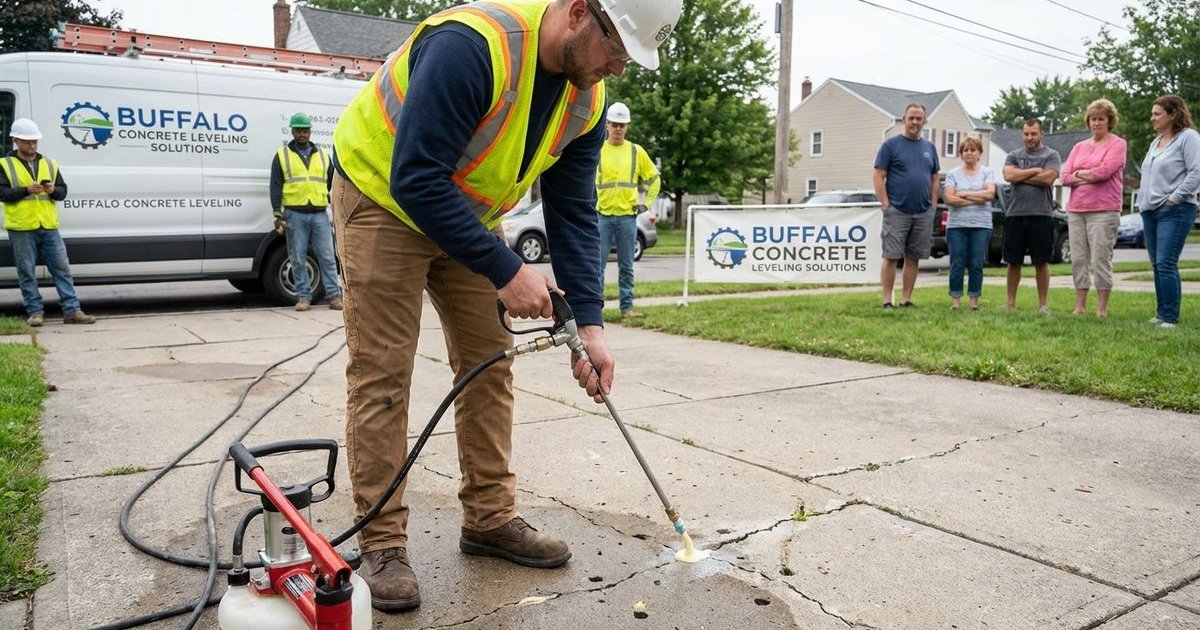
Concrete leveling is a specialized repair method that hydraulically lifts sunken slabs back to their original position without removing them. We pump a stabilizing material through small holes in the concrete to fill voids and raise the slab from below.
This process is known by a few different names in the Western New York area:
- Slabjacking: The technical term for lifting concrete with hydraulic pressure.
- Mudjacking: The traditional method using a basic soil-cement mixture.
- Limestone slurry leveling: Our preferred method that uses pulverized limestone for maximum stability.
- Foam leveling: A newer technique using expanding polyurethane (which we generally avoid for heavy load-bearing driveways).
How Concrete Leveling Works
The process is surprisingly fast and typically allows you to walk on your sidewalk or driveway the very same day. Our crew follows a precise five-step protocol to ensure the lift holds up against Buffalo’s freeze-thaw cycles.
1. Assessment and Drill Prep
We start by identifying exactly which way the slab is tilting and where the voids are located underground. Our technicians then drill a series of strategical 1-inch holes (about the size of a quarter) through the sunken concrete.
2. Injection and Lifting
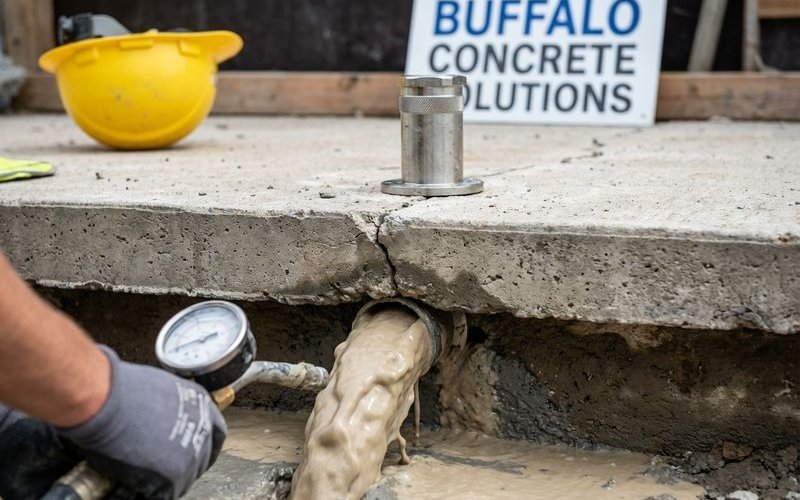
We connect a hydraulic pump to these ports and inject our limestone slurry mixture deep beneath the slab. This material fills the empty spaces first and then builds up enough pressure to physically lift the concrete.
3. Verification and Clean Up
Our team checks the grade constantly to ensure water will run away from your home’s foundation, not toward it. Once the slab is level, we patch the drill holes with a high-strength concrete mix color-matched to your existing driveway.
Insider Tip: While you can walk on the repair immediately, keep heavy vehicles off the driveway for at least 24 hours. We also recommend avoiding power washing the patched area for 48 hours to let the surface plugs fully cure.
Why Concrete Settles in Buffalo
Buffalo’s unique geology and climate create a “perfect storm” for concrete settlement. We see specific soil behaviors here that just don’t happen in other parts of the country.
The Clay Soil Factor
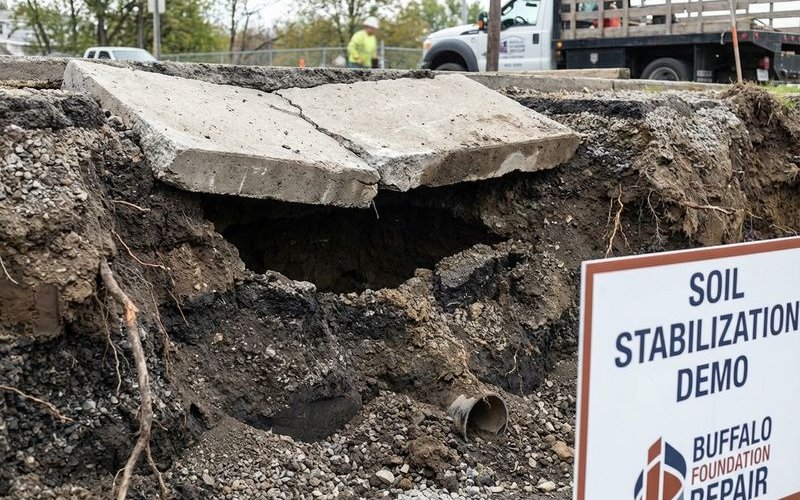
Much of Western New York sits on what geologists call “glaciolacustrine clay,” which is essentially ancient lake bottom soil. This heavy clay acts like a sponge. It swells significantly when wet and shrinks when dry, creating massive voids under your concrete that leave slabs unsupported.
The Freeze-Thaw Engine
Our region experiences over 40 distinct freeze-thaw cycles every winter. Water gets under your driveway, freezes, and heaves the slab up. When it thaws, the soil settles back down, but often lower than before.
Erosion from Drainage
We often find that downspouts discharging too close to a walkway wash away the “fill dirt” underneath. This is a common issue in suburbs like Amherst and Cheektowaga where sandy fill was often used during original construction.
When Is Concrete Leveling Right?
Not every slab can be saved, but leveling is the ideal solution for about 80% of the calls we receive. Our technicians look for specific criteria to determine if your concrete is a good candidate.
The “2-Inch Rule” Checklist:
- Is the slab largely intact? If the concrete is crumbled into gravel, it must be replaced.
- Is the drop less than 4-5 inches? We can lift significant drops, but extreme settlement might indicate a sinkhole that requires excavation.
- Is the slab “rocking”? If the slab moves when you step on it, leveling will stabilize it instantly.
- Are there tree roots? If a large maple tree is lifting the slab, the roots must be addressed before we can level it.
Pro Tip: Do You Need a Permit?
Most simple leveling repairs in Buffalo do not require a building permit because we are not changing the footprint of your driveway. However, towns like Amherst often require a permit for work on the “driveway apron” (the part near the street) because it connects to the town road. We handle these permit checks for you as part of our initial inspection.
Concrete Leveling vs Replacement
The cost difference between leveling and replacement is often the deciding factor for our clients. We have broken down the comparison to help you see the value clearly.
| Factor | Concrete Leveling | Full Replacement |
|---|---|---|
| Typical Cost | $900 - $1,800 | $3,500 - $6,000+ |
| Installation Time | 2-4 Hours | 2-4 Days |
| Cure Time | Walk same day / Drive 24 hrs | Wait 7+ days to drive |
| Landscape Impact | Zero damage to grass | Heavy equipment damage |
| Durability | 10-20+ Years | 20-30 Years |
The Bottom Line: You generally save 50% to 70% by choosing leveling over replacement. We recommend saving replacement for slabs that are cracked into three or more unmanageable pieces.
Why We Choose Limestone Slurry
Our team exclusively uses a natural limestone slurry instead of polyurethane foam for residential repairs in Buffalo. We have tested both methods and found that limestone offers superior long-term performance in our climate.
Superior Stability
Limestone slurry cures into a hard, rock-like material that is effectively incompressible. Foam is lightweight (2-4 lbs per cubic foot), which is great for some applications, but we prefer the density of limestone to resist the extreme frost heave forces in WNY.
Void Filling Capability
We can pump limestone slurry to fill every nook and cranny of a large void without it expanding uncontrollably. This ensures the entire slab is supported by a solid base, not just pockets of air and foam.
Environmental Safety
Limestone is a natural mineral that poses no risk to your soil or groundwater. Our mix is eco-friendly and safe for use around gardens, pets, and children immediately after installation.
Get Your Free Assessment
If you are tired of tripping over that one uneven slab or worrying about your snowblower next winter, let us take a look. We offer free, honest assessments for homeowners across Buffalo, Amherst, Cheektowaga, and the Southtowns.
Contact us today to schedule your evaluation. We will tell you exactly what your concrete needs—even if that means telling you to replace it instead of hiring us.